
When a child enters an emergency department (ED), their care depends on that facility’s “readiness” — the right-sized equipment, pediatric-trained staff and established safety protocols.
Four leading health care organizations have published the updated 2026 joint policy statement: Pediatric Readiness in the Emergency Department. The American Academy of Pediatrics, American College of Emergency Physicians and Emergency Nurses Association were joined for the first time by the American College of Surgeons in this update.
What’s new in the 2026 policy statement
Building on a foundation established in 2001, the 2026 update reaffirms core readiness components and adds new areas of focus for all EDs:
 Addressing social determinants of health
- Emergency medical services collaboration
- Immediate access to pediatric resuscitation cart
- Pediatric-specific quality measures
- Screening for human trafficking and suicide
- Standardized clinical algorithms
Take the Pediatric Readiness Assessment today
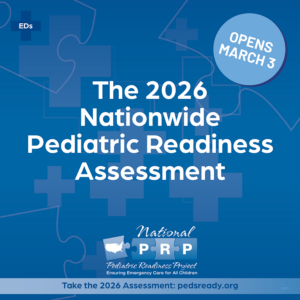
We cannot improve what we do not measure. The National Pediatric Readiness Project has officially opened the 2026 Pediatric Readiness Assessment based on the updated guidelines in the 2026 Joint Policy Statement. This confidential, web-based tool allows your ED to compare its capabilities against these new national standards.
After completing the assessment, your ED receives a gap report identifying exactly where your department can improve to better serve its youngest patients. The data is clear – high levels of readiness save lives. Research shows that in EDs scoring above 88 on the assessment, critically ill children have a 76% lower risk of death[1]. For children with major trauma, that readiness is associated with a 60% reduction in mortality[2].
.
Visit PedsReady.org now through May 31 to take the assessment.
.
[1] Ames SG, Davis BS, Marin JR, Fink EL, Olson LM, Gausche-Hill M, Kahn JM. Emergency Department Pediatric Readiness and Mortality in Critically Ill Children. Pediatrics. 2019 Sep;144(3):e20190568. doi: 10.1542/peds.2019-0568. Erratum in: Pediatrics. 2020 May;145(5):e20200542. doi: 10.1542/peds.2020-0542. PMID: 31444254; PMCID: PMC6856787.
[2] Newgard CD, Lin A, Malveau S, et al. Emergency Department Pediatric Readiness and Short-term and Long-term Mortality Among Children Receiving Emergency Care. JAMA Netw Open. 2023;6(1):e2250941. doi:10.1001/jamanetworkopen.2022.50941

Written by:
Carissa Brunner, MPH, CLC
Program Leader